
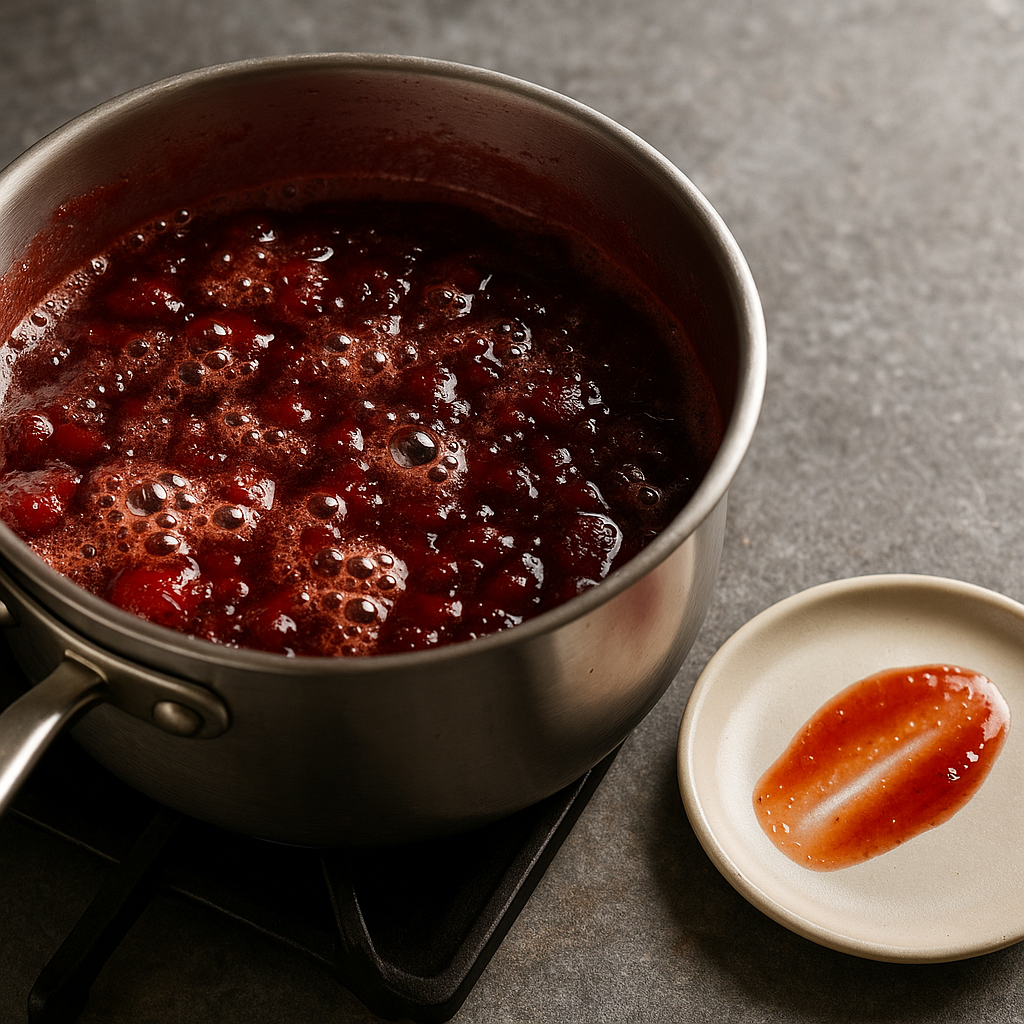
The Science Behind Jam Setting: Pectin Explained
Jam sets when pectin molecules link up in the right conditions. Sugar and acidity help the gel to form and hold. Here’s the science in plain English—no full recipes given, just enough to understand what’s going on in the pan.
Quick Answer
Jam sets when pectin (a natural fruit fibre) forms a network in the presence of the right amount of sugar and acidity at the right temperature. If any one of those—pectin, sugar, acid or heat—is out of balance, you get runny jam, rubbery jam or weeping jam instead of a smooth, spoonable set.
Free Fermentation Safety Checklist
Although jam uses sugar and heat rather than fermentation, many home preservers make both. If you’re also fermenting veg or chilli sauces, my Fermentation Safety Checklist (PDF) walks through the key checks for safe, reliable ferments.
Get the Free ChecklistPectin, sugar, acidity—how the gel forms
Jam isn’t just “thick fruit”. At the microscopic level, three things work together:
- Pectin: a natural gelling fibre found in the cell walls of many fruits.
- Sugar: ties up some of the water in the pan so pectin molecules can get close enough to form a network.
- Acidity: adjusts the pH so pectin strands are less “charged” and more willing to link up.
When you boil fruit, sugar and acid together to the right concentration, pectin molecules bond into a loose three-dimensional net. Water and fruit pieces get trapped in that net—and once the jam cools, it holds its shape instead of pouring like syrup.
What exactly is pectin?
Pectin is a type of soluble fibre found in fruit cell walls, especially in:
- Apple cores and peels
- Citrus peel and pith
- Quince and some berries
Unripe fruit often contains more pectin than very ripe fruit. That’s why some recipes suggest mixing slightly under-ripe fruit with ripe fruit, or adding a homemade pectin source like apple or lemon.
Fruit by pectin level (broad categories)
This rough guide helps explain why some fruits set more easily than others:
| Higher pectin | Lower pectin |
|---|---|
| Apples, citrus peel, quince, blackcurrants, redcurrants | Strawberries, cherries, raspberries, peaches, pears, apricots |
High-pectin fruits often need less added pectin. Low-pectin fruits commonly need either commercial pectin, a pectin-rich fruit mixed in, or a carefully balanced recipe to reach a good set.
Why sugar matters (and why you can’t just “cut it a bit”)
In traditional jam recipes, sugar isn’t just for sweetness:
- It helps pull water away from the pectin and fruit so the gel can form.
- It contributes to the final texture and shine.
- It plays a role in shelf life once jars are processed and sealed.
Casually reducing sugar in a standard recipe can mean:
- The jam never sets properly (stays runny).
- The set is weak and weeps liquid over time.
If you want lower-sugar jams, it’s important to use recipes and pectins designed for that purpose, not just halve the sugar and hope.
The role of acidity
Most jam recipes rely on the natural acidity of the fruit, sometimes topped up with lemon juice. Acidity:
- Adjusts the pH so pectin strands are less repelled by each other.
- Helps pectin form a stable gel at the right sugar concentration.
- Brightens flavour so the finished jam doesn’t taste flat or overly sweet.
Too little acid and your jam may be loose and lacking sparkle. Too much and it can taste sharp or harsh. Tested recipes balance this so you don’t have to guess.
Temperature and the “set point”
As jam boils, water evaporates and sugar concentration rises. Traditional recipes often mention a target temperature for the set point. At that stage:
- The mixture has reached a sugar concentration high enough for gel formation.
- Pectin, sugar and acid are all in the right range.
Different recipes may give slightly different numbers depending on the fruit, sugar and equipment. That’s why a thermometer plus a simple cold-plate test work well together.
Common problems & quick checks
If your jam doesn’t behave as expected, it usually comes back to pectin, sugar, acidity or time.
- Runny set: often caused by low pectin fruit, too little sugar, not enough acidity, or undercooking. The usual fix is a carefully controlled reboil with either added pectin source or a tested rescue method—not guesswork.
- Too firm or rubbery: can mean too much pectin, too much sugar, or overcooking. Gentle reheating with a measured amount of added liquid can help loosen texture.
- Weeping (syneresis): where liquid seeps out of an apparently firm jam. This can happen when the gel is over-tight, or the sugar distribution is uneven.
The key is to diagnose which part of the pectin–sugar–acid–heat balance is off, then use a method designed to correct that specific issue.
Want tested, reliable jam methods?
My jam book walks through fruit-by-fruit guidance, exact temperatures, quantities and troubleshooting so you can stop guessing and get consistent sets.
Ready to put the science into practice?
Precise temperatures, step-by-step methods and fruit-by-fruit advice are in:
Jam, Jelly & Marmalade — The Beginner’s Guide Pickling for the Absolute Beginner
Summary
Jam doesn’t set by magic. Pectin, sugar, acidity and heat all have to line up so a stable gel can form as the pan cools. High-pectin fruits and balanced recipes make life easier; low-pectin fruits need a bit more help. Once you understand what each part is doing, it’s much easier to follow a recipe, recognise what’s happening in the saucepan and fix problems calmly when they appear.