
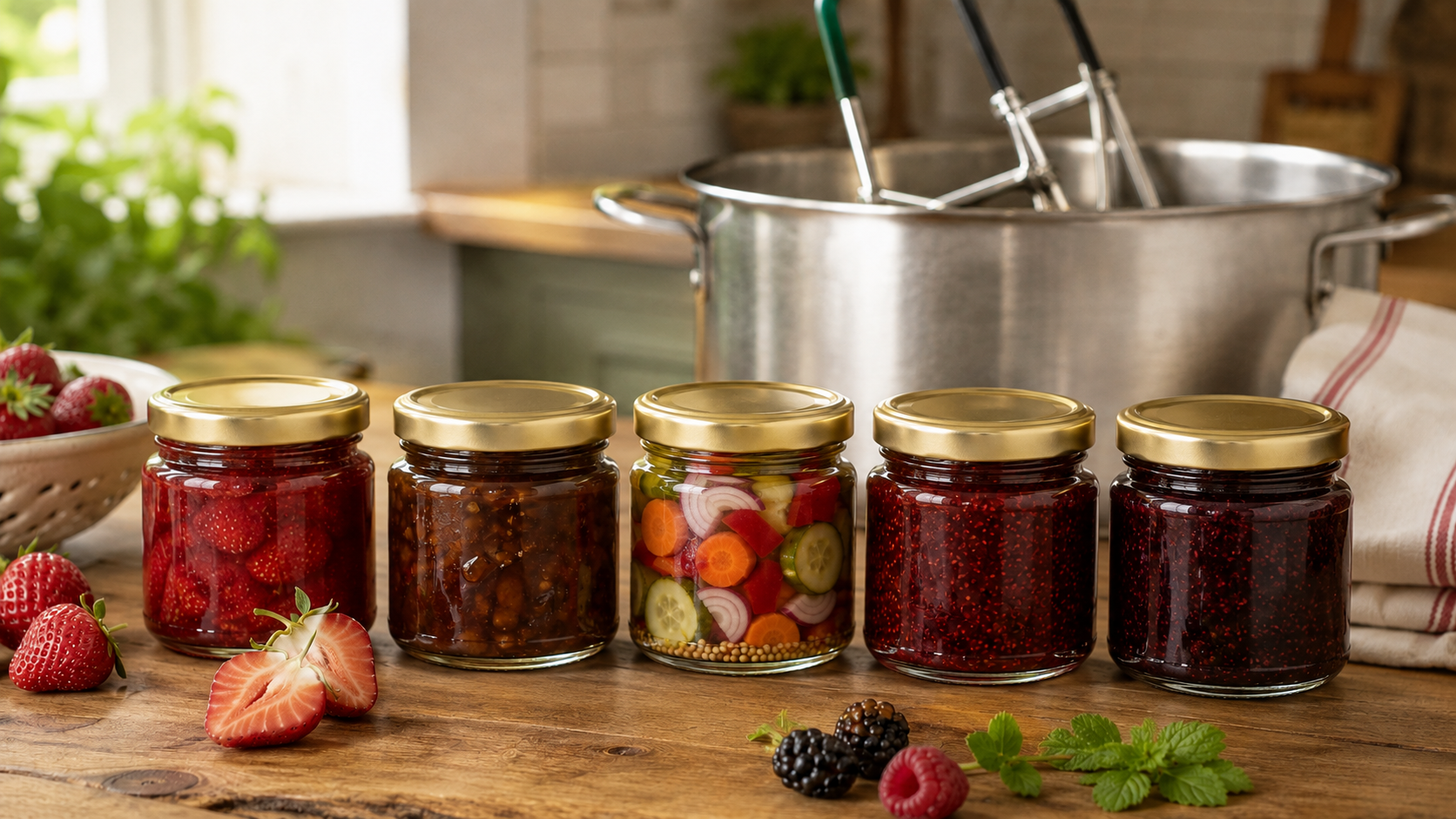
How to Seal Jars of Jam, Chutney and Pickles
Part of the Fermentation & Preserving Guides hub.
There is more than one way to seal a jar of jam, chutney or pickles. However, the right method depends on the food inside the jar. A lid can form a strong vacuum seal while the contents remain unsuitable for room-temperature storage, so sealing and preserving must never be treated as the same thing.
Quick answer
Hot filling into suitable jars with twist-off lids is a common method for traditional full-sugar jams, marmalades and properly formulated acidic chutneys. Boiling-water-bath processing gives suitable high-acid foods an additional controlled heat treatment after filling. Pressure canning is used for validated low-acid foods because it reaches temperatures above boiling point. A vacuum pump may close a jar, but vacuum sealing alone is not a preservation process.
Free Fermentation Safety Checklist
Making pickles or fermented vegetables? Get my Fermentation Safety Checklist (PDF) and avoid common beginner mistakes with ingredients, hygiene and storage.
Get the free checklistJar-sealing methods at a glance
The methods are not interchangeable. Each one creates or maintains a seal differently, and each has its own limits.
Commonly suitable for acidic preserves
- Hot filling with suitable twist-off lids
- Boiling-water-bath processing
- Validated hot-fill-and-hold processes
- Traditional covers for short-term jam storage, although less reliable than modern lids
Not a universal solution
- Vacuum pumps or vacuum-sealing attachments
- Turning jars upside down
- Heating jars in a domestic oven
- Reusing damaged or unsuitable lids
- Assuming any sealed food is safe at room temperature
1. Hot filling with twist-off lids
This is the method I use for my own jams, marmalades and chutneys. The hot preserve is transferred into a clean, suitable jar, the rim is checked and the twist-off lid is fitted immediately. As the product and the air in the headspace cool, they contract and create a partial vacuum. This pulls the lid down and produces the familiar firm, concave centre.
Advantages
- Simple and efficient for suitable hot, acidic preserves
- No separate water-bath stage is required when a properly established hot-fill process is being followed
- Modern twist-off lids make the vacuum relatively easy to check
- Well suited to small-batch production when filling temperature, headspace and closure are controlled
Disadvantages and limitations
- It is not suitable for every recipe or every type of food
- The product must be sufficiently hot when filled and must not cool excessively during a long filling run
- Jars and lids must be intended for hot filling and used according to the supplier’s instructions
- A vacuum may form even when the recipe itself is unsafe
Hot filling works as part of a complete preservation process. It must not be reduced to “put hot food in a jar and wait for the lid to pop”. The formulation, acidity, heat treatment, filling temperature, hygienic handling and closure all matter.
2. Boiling-water-bath processing
With this method, filled and closed jars are placed in boiling water and processed for the time specified by a validated recipe. The water must surround the jars, and the processing time begins only when the water has returned to the required boil.
Water-bath processing is intended for suitable high-acid or correctly acidified foods. It is widely used for jams, fruit preserves and vinegar pickles in countries such as the United States. It provides a controlled heat treatment after filling and helps drive air from the headspace so that a vacuum forms during cooling.
Advantages
- Provides an additional, measurable heat-processing stage
- Can improve seal reliability when the correct jars and closures are used
- Processing times are available for many established recipes
Disadvantages and limitations
- It takes additional time and equipment
- It is only appropriate where the recipe and processing schedule are suitable
- Excessive processing may soften pickles or affect the colour and set of some preserves
- An American processing time should not automatically be applied to a different recipe, jar size or closure
- Boiling water does not make an unvalidated low-acid food safe for ambient storage
3. Pressure canning
A pressure canner is a purpose-made piece of equipment that processes food under pressure, allowing temperatures above the normal boiling point of water to be reached. It is used with scientifically validated processes for many low-acid foods, such as certain vegetables, meat and soups.
A pressure canner is not the same as an ordinary pressure cooker, and it must be used with the correct jar size, food preparation, pressure, processing time and altitude adjustment specified by a reliable validated source.
Advantages
- Can process certain low-acid foods when a validated pressure-canning method exists
- Reaches temperatures that cannot be achieved in an ordinary boiling-water bath
Disadvantages and limitations
- Specialist equipment and careful process control are required
- It is less familiar and less commonly supported for home preserving in the UK
- You cannot safely invent a processing time for your own recipe
- Not every jar or twist-off lid is suitable for pressure canning
4. Hot-fill-and-hold processing
Commercial producers may use a validated hot-fill-and-hold process. The product is filled at or above a specified temperature, closed, and held for a defined time so that the container and closure receive the intended heat treatment. Depending on the validated process and container design, the jar may be inverted briefly to ensure that the hot product contacts the lid.
This is not the same as casually turning a jar upside down and hoping that it seals. A commercial hot-fill-and-hold process has defined controls for recipe, pH, temperature, time, container, closure and cooling.
Advantages
- Efficient for suitable pourable, acidic products
- Can give the container and closure a controlled heat treatment
- Can be incorporated into a documented commercial production system
Disadvantages and limitations
- The process must be established and validated for the particular product and packaging
- Temperature and holding time need to be monitored and recorded
- It cannot compensate for inadequate acidity or an unsuitable recipe
5. Vacuum-sealing pumps and attachments
Some appliances remove air from a jar and produce a vacuum without heat processing the food. This may be useful for protecting the quality of dry ingredients or for short-term refrigerated storage where appropriate. However, it does not cook, pasteurise or acidify the contents.
Advantages
- Can reduce exposure to air
- May help protect the quality of suitable dry foods
- Can provide a convenient reusable closure for appropriate foods
Disadvantages and limitations
- It is packaging, not a substitute for a validated preservation process
- It does not destroy harmful microorganisms
- Removing oxygen can favour microorganisms that grow in low-oxygen conditions if the food itself is not properly controlled
- It must not be used to make an unproven pickle, chutney or oil product appear shelf-stable
6. Wax discs and cellophane covers
Waxed discs and cellophane covers are traditional British jam-making supplies. The wax disc sits on the surface of the hot jam and the dampened cellophane cover shrinks as it dries. They may help protect a correctly made traditional jam, but they do not give the same tamper evidence or robust vacuum seal as a modern food-grade lid.
Advantages
- Inexpensive and familiar to traditional jam makers
- Useful where a jar has been designed for this type of cover
Disadvantages and limitations
- Less secure than a suitable modern metal closure
- No vacuum-button check
- Greater potential for leakage, damage or mould if preparation and storage are poor
- Not appropriate for chutneys, vegetables in oil or low-acid foods
7. Inverting jars
Some people fill a jar, fit the lid and turn it upside down. The intention is to expose the lid to the hot product and encourage a seal. This is sometimes a defined step within a validated commercial hot-fill-and-hold process, but inversion by itself is not a reliable substitute for proper processing.
It may also allow food to lodge around the lid compound, make the headspace less consistent and create a false sense of security. If the validated process you are following does not require inversion, do not add it simply because it is traditional.
8. Oven processing
Heating empty jars in an oven is sometimes used as part of jar preparation where the jar manufacturer permits it. That is different from trying to process filled jars in a domestic oven.
Dry oven air transfers heat less evenly than boiling water, filled jars may be exposed to thermal stress, and ordinary jar and lid systems may not be designed for oven processing. Do not invent an oven temperature and time as an alternative to an established hot-fill, water-bath or pressure-canning process.
A sealed jar is not necessarily shelf-stable
This is the most important point in this guide. A depressed lid or strong vacuum tells you that the closure has sealed. It does not prove that the food was safe when it entered the jar or that it can safely remain at room temperature.
What else determines safety and shelf life?
The safety and stability of a preserved food may depend on several controls working together:
- The complete recipe: Ingredients and proportions must not be changed casually.
- Acidity: The final equilibrium pH must be appropriate throughout the food—not just in the surrounding liquid or on the surface.
- Sugar, salt and available water: These may restrict microbial growth, but only when present at effective levels.
- Vinegar: Pickling recipes rely on food-grade vinegar of known acidity in the correct proportion.
- Heat treatment: Cooking, filling and any post-fill processing must achieve the intended time and temperature.
- Cleanliness: Jars, lids, utensils, work surfaces and hands must be properly cleaned and handled hygienically.
- Packaging: The jar, closure, headspace and seal must all be suitable for the product and process.
- Storage: Some products are intended for ambient storage; others must remain refrigerated.
- Shelf-life evidence: A commercial producer must be able to justify the date and storage instructions applied to the product.
Why traditional jam is usually shelf-stable
Traditional full-sugar fruit jam made from an established recipe is generally considered a relatively low-risk preserve because several controls work together:
- Most fruits used for jam are naturally acidic
- The recipe may include additional lemon juice or another acid where required
- A high concentration of sugar reduces the water available for microorganisms to grow
- Boiling gives the product a substantial heat treatment
- Hot filling into clean, suitable jars helps prevent recontamination and creates a vacuum seal
When a recognised full-sugar recipe and a controlled hot-fill process are followed correctly, an unopened jam is commonly given a best-before period of around 12 months. That does not mean every product called jam automatically has a 12-month life. Reduced-sugar jam, unusually low-acid ingredients, major recipe changes, poor filling control or contamination can alter the position.
Best-before date or use-by date?
Properly produced shelf-stable jam, marmalade and chutney would normally carry a best-before date, which relates primarily to quality. A use-by date is a safety date used for highly perishable food that may become unsafe after a short period.
A best-before date is not permission to guess. Anyone selling food remains responsible for ensuring that the product is safe, appropriately processed and labelled, and that its shelf life can be justified.
Chutneys and cooked vinegar pickles
Chutneys and cooked pickles can be suitable for ambient storage when made from an established formulation containing sufficient food-grade vinegar, cooked and reduced correctly, filled hot and sealed using a suitable process. The pH must be controlled throughout the product, including within pieces of fruit or vegetables after the acidity has had time to equalise.
“It contains vinegar” is not enough. Reducing the vinegar, increasing the vegetables, adding water or using weaker vinegar can change the safety of the recipe even if the finished jar seals perfectly.
Raw pickles, dry pickles and pickles in oil
These products need particular care because the name “pickle” covers many very different foods. A raw pickle may not receive a heat treatment. A so-called dry pickle may still contain enough moisture to support microbial growth. Vegetables, garlic, chillies or herbs covered in oil may create a low-oxygen environment.
Clostridium botulinum, the organism associated with botulism, can grow and produce toxin in suitable low-oxygen conditions when the food’s other controls are inadequate. Oil is not a preservative merely because it excludes air, and cooking the ingredients does not automatically make the finished jar shelf-stable.
Unless an oil-based pickle has a professionally validated formulation and process, it should not be presented as an ambient, long-life product simply because the jar has formed a vacuum. Someone intending to sell this type of product should discuss the formulation, process, storage conditions and shelf-life evidence with their local environmental health team and a suitably qualified food laboratory or food technologist.
Checking a twist-off lid after cooling
Allow jars to cool undisturbed. Then check each jar individually:
- The centre of a vacuum-button lid should be drawn down and should not flex or click when pressed
- There should be no leakage, cracks, damaged threads, distorted lids or product trapped in the closure
- The seal should remain intact during storage
- Any jar that has failed to seal must not simply be placed on the shelf; follow the recipe’s safe instructions for refrigeration, reprocessing or disposal
Never taste food from a jar that is leaking, bulging, spurting, unusually pressurised, badly discoloured, mouldy or otherwise suspicious. Some dangerous contamination cannot be seen, smelled or tasted, so appearance alone is not proof of safety.
Which sealing method should I choose?
Start with the food and a reliable established recipe—not with the lid. The recipe and its validated process should tell you which jar, closure, filling temperature and processing method are appropriate.
- Traditional full-sugar jam and marmalade: hot filling into suitable jars with compatible twist-off lids is commonly used when the established recipe and process support it.
- Properly formulated acidic chutney: a controlled hot-fill process may be appropriate; follow the established recipe and packaging instructions.
- Acidified vinegar pickles: follow a validated recipe, which may specify boiling-water-bath processing.
- Low-acid vegetables, meat or soups: use only a scientifically validated pressure-canning process with suitable equipment and packaging.
- Raw, dry or oil-based pickles: do not assume ambient stability; obtain product-specific professional advice and validation.
Want clear guidance for jam, chutney and pickles?
My beginner-friendly books explain ingredients, preparation, jar filling and storage in a clear, practical way.
Preserve with confidence
For practical guidance on pickling, preserving and fermentation, explore my complete collection of straightforward books written for beginners and home producers.
Summary
Hot filling, boiling-water-bath processing and pressure canning can all create sealed jars, but they are intended for different foods and processes. Vacuum pumps, inversion and traditional covers may also close or protect a container, but they do not make an unsuitable recipe safe.
The most important rule is simple: a sealed lid proves that the jar is sealed—it does not prove that the contents are shelf-stable. Use an established recipe, control acidity and other preservation factors, follow the specified heat process, use suitable jars and lids, work hygienically and apply a shelf life that you can justify.
If you are developing your own recipe for commercial sale—particularly an unusual chutney, pickle, reduced-sugar preserve or product containing oil—you can approach a specialist food laboratory or food technologist. They can assess your recipe and production process and advise which tests are required. These may include pH, water activity, microbiological analysis, challenge testing and a shelf-life study using samples stored and tested over time.
Professional assessment can provide scientific evidence to help validate whether a product is suitable for room-temperature storage and whether, for example, a 12-month best-before period is reasonable. However, testing one jar on one occasion does not automatically validate every future batch. The recipe, production process, packaging and storage conditions must remain consistent, and the food business remains responsible for the product and the date placed on its label.
UK food-testing and shelf-life specialists
The following established organisations offer relevant food-testing and shelf-life services:
- Campden BRI: Shelf-life evaluation, microbiological assessment, challenge testing, predictive microbiology and technical advice. Visit Campden BRI
- Eurofins Food Testing UK: Shelf-life validation, food microbiology, challenge testing and food-safety consultancy. Visit Eurofins Food Testing UK
- ALS UK: Ambient and refrigerated shelf-life evaluation, microbiological testing and bespoke shelf-life trials. Visit ALS UK
Before sending any jars, contact the laboratory and explain:
- The exact product and complete recipe
- Whether it will be sold commercially
- Your cooking and hot-fill process
- The jar size and type of closure
- The intended storage conditions
- The shelf life you hope to apply
- Whether the product contains oil, fresh herbs, garlic or chillies
Ask the provider to recommend an appropriate shelf-life validation plan rather than simply requesting a general “food safety test”. The testing required will depend on the ingredients, processing method, packaging, storage conditions and risks associated with the individual product.